1) Name, Taxonomy and Etymology
My interest in roses began during childhood in Iran, when my parents established a large garden around our new home. Some plants arrived before our family moved in, and roses were part of that special group. When I was eight or nine, I was especially fascinated by two plants we called “seven-colored roses.” Their flowers began with vivid red, orange, and yellow tones and changed as they matured, sometimes becoming red and white. They were not fragrant, but their changing colors stayed with me. Later, the plants developed serious health problems and were removed because they appeared to be affecting nearby roses. I never learned exactly what was wrong with them.
Years later, that memory influenced my choice of roses for my own garden. I bought five Rio Samba plants, gave one to my parents, and kept four. Their colorful flowers reminded me of the roses I had known in Iran, although I cannot identify those childhood plants as the same cultivar. I planted my garden roses in June 2024. Growing them has brought back an old question: why do some roses remain vigorous while others struggle, even when their flowers initially look equally impressive?
The crop at the center of this report is the hybrid tea rose, a horticultural class within the genus Rosa and the family Rosaceae. Hybrid teas have a complex breeding history rather than belonging to a single wild species. The name Rosa × hybrida is used in horticultural research for cultivated hybrid roses, but it is broader than the hybrid tea class. A cultivar name, such as Rosa ‘Rio Samba’, identifies a particular cultivated selection. The genus is italicized; the cultivar name is written in single quotation marks without italics (Kılıç, 2023).
Rosa is the classical Latin name for the rose. “Hybrid tea” refers to the class’s ancestry, combining earlier hybrid perpetual and tea roses. The resulting roses became known for repeat flowering and the elegant flower form associated with long-stemmed cut roses (Barrett, 2013). My garden also contains roses from other classes, which provide useful comparisons without making them all hybrid teas. One pink rose has lost its tag, so I record it as a rose of unknown cultivar rather than assign a name from its flower alone.
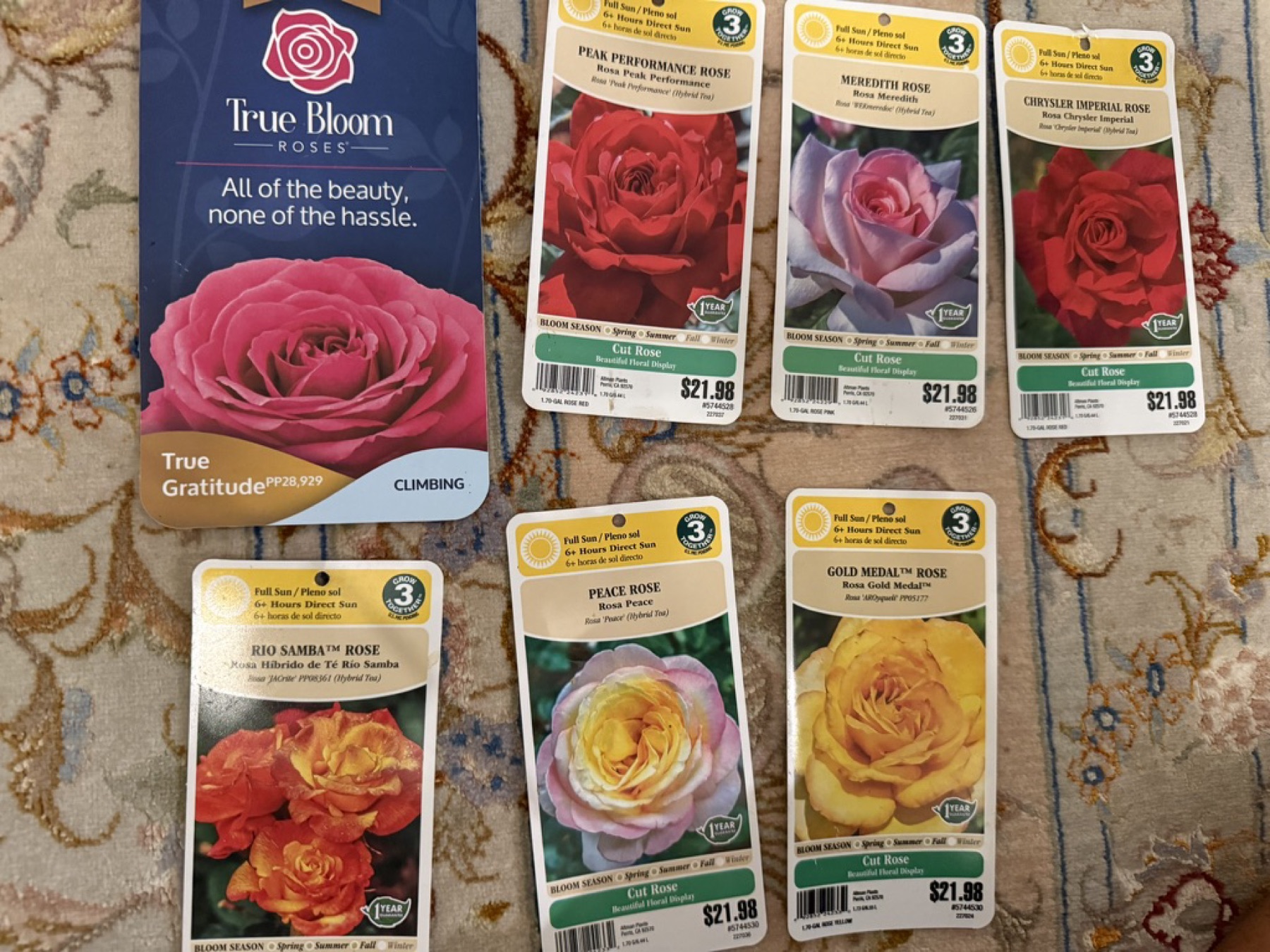
Figure 1. Labels retained from my rose purchases, including Rio Samba, Peace, Chrysler Imperial, Meredith, Peak Performance, Gold Medal, and True Gratitude. The labels document the names under which the plants were sold; they are not a record of how each plant subsequently performed. Photograph by the author.
2) Origin, Production and Uses
The roses I grow are part of a much longer history of moving plants between countries and selecting them for desirable traits. Hybrid tea roses developed through crosses involving earlier European and Chinese rose groups. Repeat-flowering Chinese roses introduced into Europe helped breeders combine recurrent bloom with other qualities, including flower size, form, and hardiness. The hybrid tea class is conventionally dated to 1867 (Barrett, 2013). Its development helps explain why a garden rose is more than a naturally occurring species: it carries generations of choices about the kind of flower people want to grow.
For me, the most immediate uses of roses are their beauty in the garden and the pleasure of watching their flowers change. For commercial growers, flower quality must also translate into a product that can be harvested, handled, transported, and sold. Hybrid tea roses are important ornamental plants because of their large flowers and suitability for cutting. Breeding research considers traits such as flower-stem length, petal number, scent, and reproductive fertility, illustrating the range of characteristics involved in developing new cultivars (Kılıç, 2023).
The scale of the trade is far removed from my front yard. In a dated U.S. market snapshot, USDA’s Economic Research Service reported more than $800 million in fresh-cut rose imports in fiscal year 2022. Across the broader category of cut flowers, plants, and nursery stock, Colombia was the largest supplier by value, and Ecuador was also among the leading suppliers. These figures describe trade rather than a count of roses produced, and the broader supplier ranking includes products other than roses (Scott, 2023). They nevertheless show why roses matter as a specialty crop beyond individual gardens.
Roses also connect my interest in horticulture with Iranian culture. Damask rose, Rosa damascena, is associated with rosewater and rose oil, whose uses extend into food, fragrance, and traditional medicine. These uses belong especially to aromatic roses and should not be assumed for every hybrid tea. Research reviews document the traditional uses and biological activities studied in Damask rose, although those findings do not establish that a garden rose product treats a medical condition (Boskabady et al., 2011). A rose can therefore be a landscape plant, a cut flower, or a raw material for another product, depending on which rose is grown and why.
My Rio Sambas bring those choices back to a personal scale. Their color attracted me first, but maintaining the plants has made foliage, vigor, and repeat performance just as important. I began by wondering whether selecting roses for unusual flowers might involve tradeoffs in resilience. My own garden cannot answer that breeding question, especially because the four Rio Sambas have not performed alike. It has instead given me a reason to examine cultivar choice together with growing conditions and care.
3) Plant Description and Growth Stages
Hybrid tea roses are woody perennial shrubs that produce new shoots and repeated flowering flushes. Their mature dimensions vary by cultivar. Weeks Roses describes Rio Samba as a rounded plant about five to six feet tall. Gold Medal, the grandiflora I use for comparison, is listed at about six feet tall with an upright habit (Weeks Roses, n.d.-a, n.d.-b). Width also varies; the broader genus includes plants roughly two to six feet wide, but that range is not a measurement of my individual roses (North Carolina State Extension, n.d.).
Rose canes carry alternate, pinnately compound leaves with serrated leaflets. The sharp projections along the stems are prickles, although they are commonly called thorns. Seasonal growth includes new canes and foliage, bud development, flowering, and, where flowers are retained and successfully pollinated, hip development. Winter leaf retention and dormancy vary with climate. A rose hip is an accessory fruit containing the hard achenes, which are the true fruits (North Carolina State Extension, n.d.).
In my garden, the spring flowering of Rio Samba is especially noticeable because several flower colors appear on a plant at once. The March 22 photographs show open flowers and buds, while the April 13 photograph shows a cluster at different stages of development. Although hybrid teas are often pictured with one flower on a stem, Rio Samba can produce small clusters, a feature also described by Weeks Roses (n.d.-b). These photographs document differences among flowers on a given date; they do not track a single flower through its entire color change.
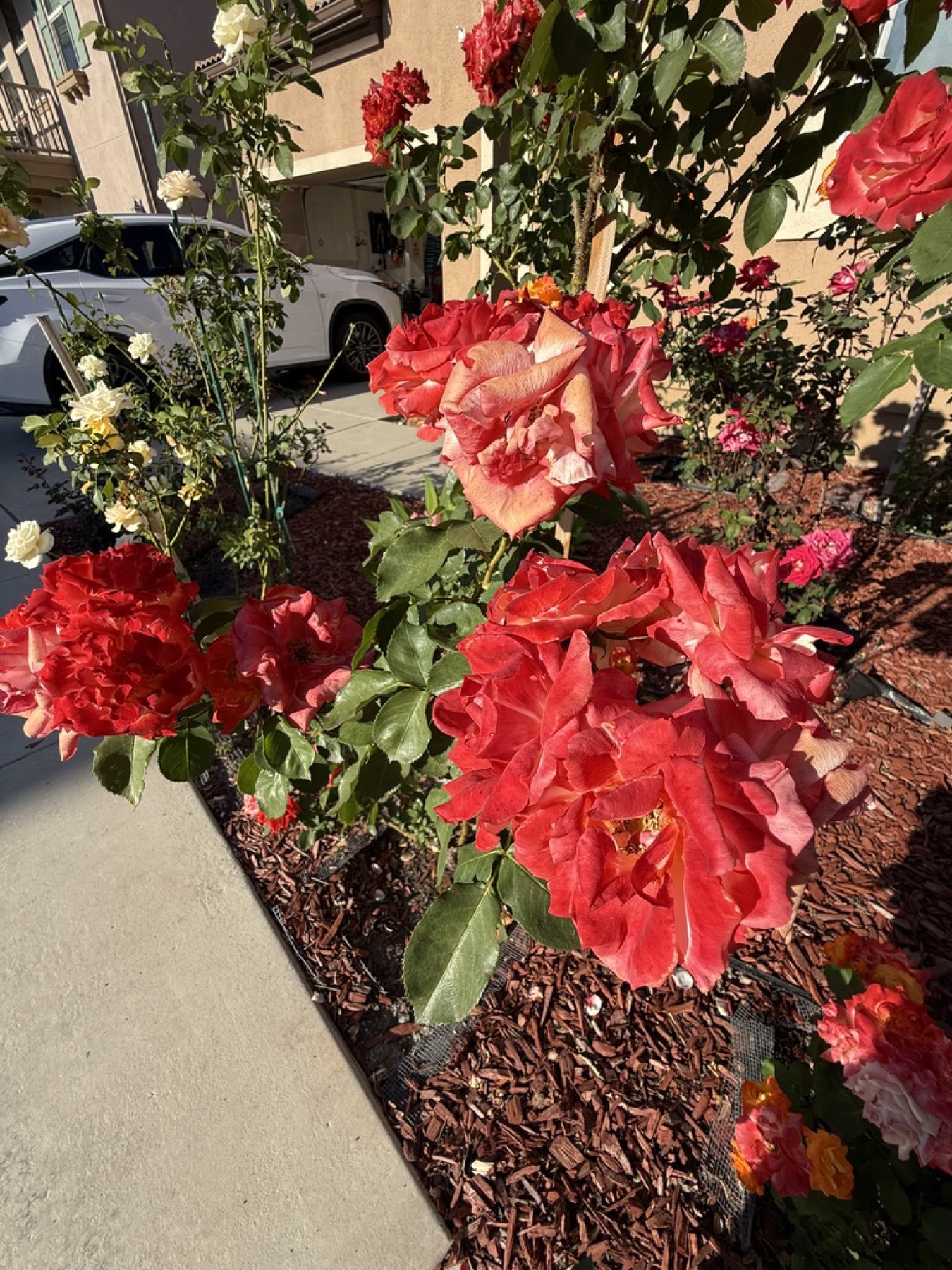
Figure 2. Rio Samba on March 22, 2026, showing abundant open flowers and foliage. Photograph by the author.
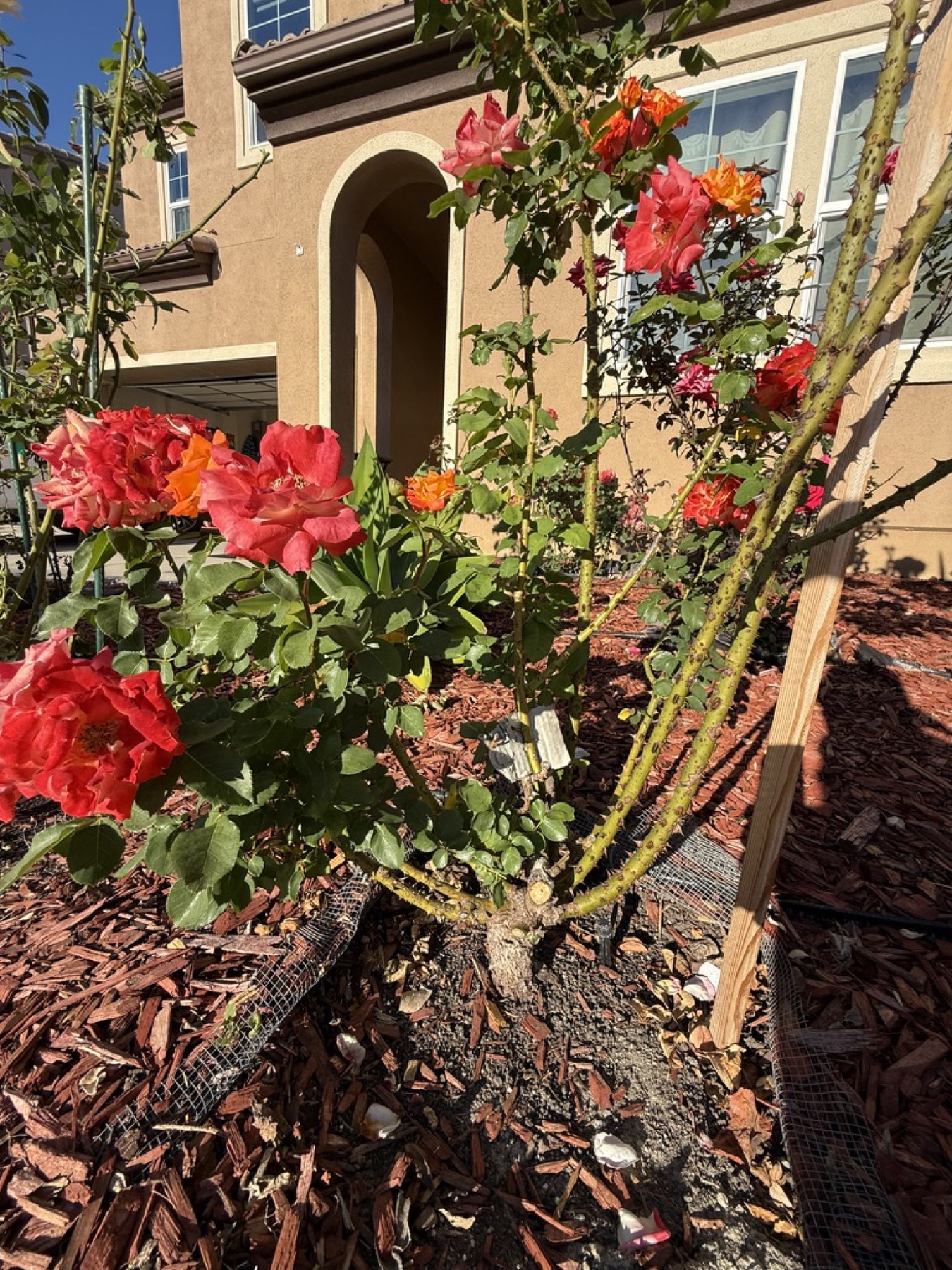
Figure 3. Rio Samba on March 22, 2026, showing the cane framework, branching, and support stakes. This view provides context for my later observations of changes in cane growth. Photograph by the author.
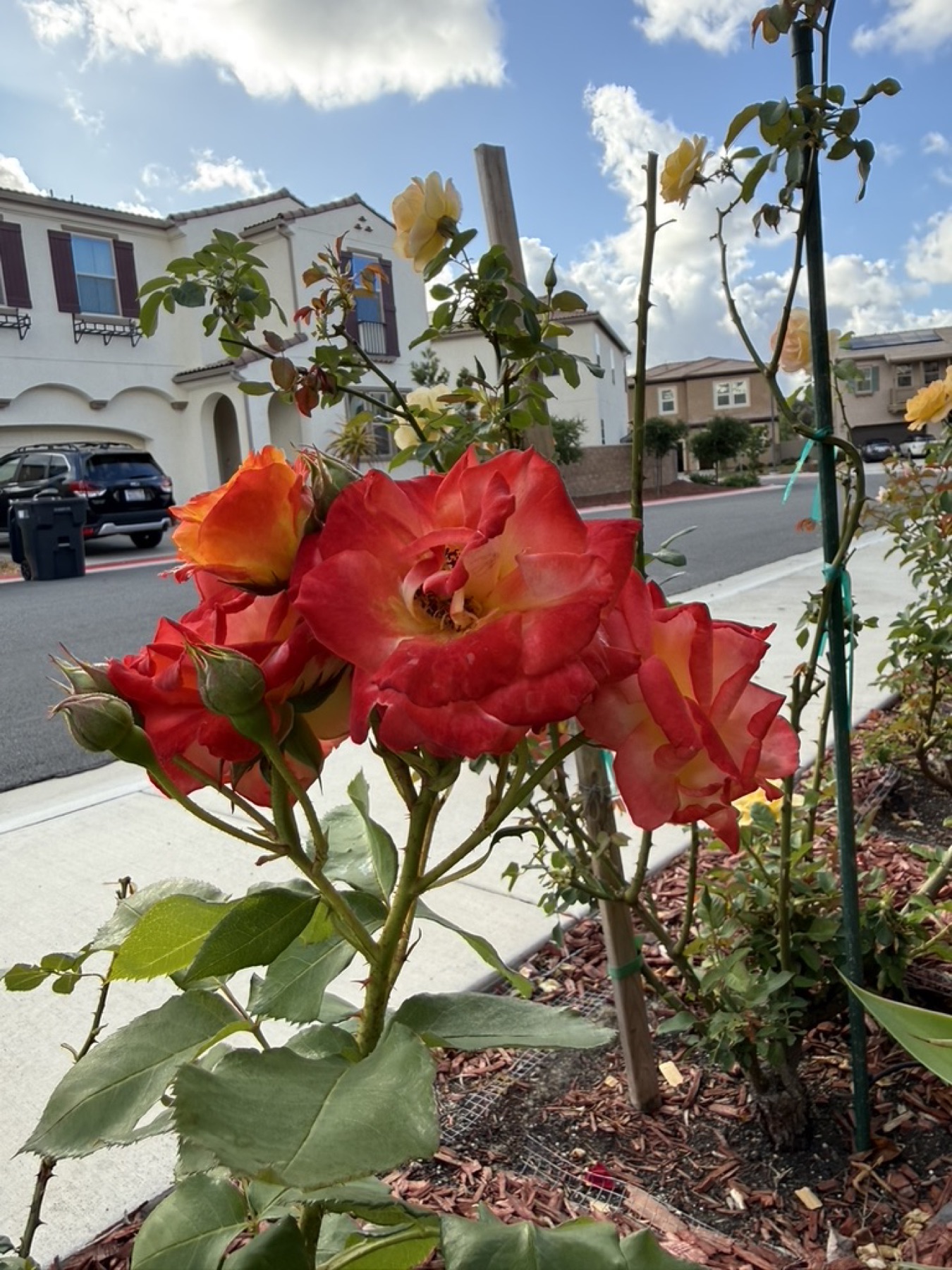
Figure 4. A Rio Samba cluster on April 13, 2026. Buds and open flowers illustrate the variety of color and flower stages present together. Photograph by the author.
Flowers are only one part of the growth cycle. Leaves support the next flush, so I now pay closer attention to whether a plant retains foliage after flowering. Hips would show a further stage, but I have not supplied a photograph documenting hips on these plants. My deadheading also removes many flowers before fruit can develop. Pollinator access varies with flower form; open flowers with accessible reproductive structures differ from densely double blooms (North Carolina State Extension, n.d.).
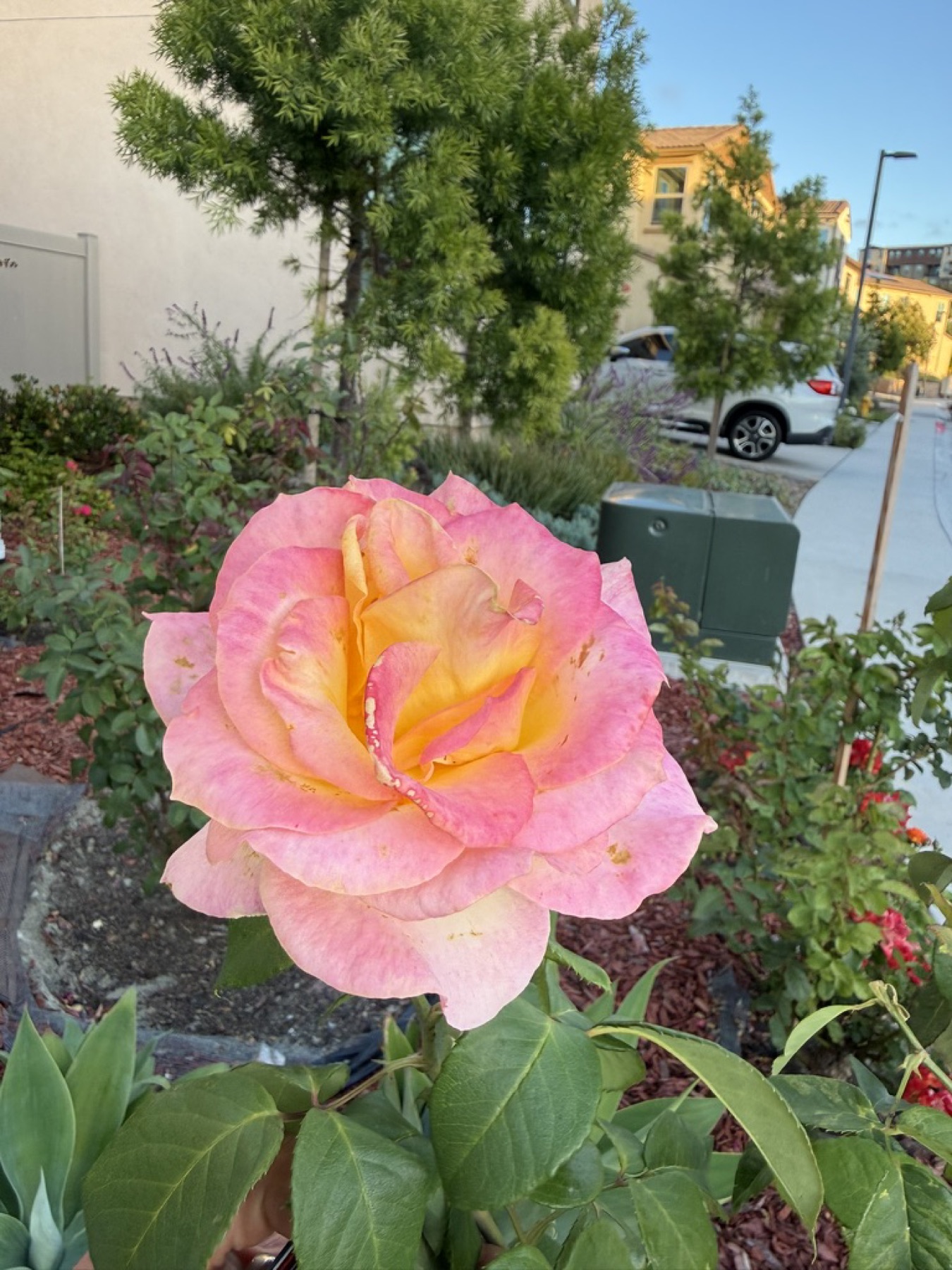
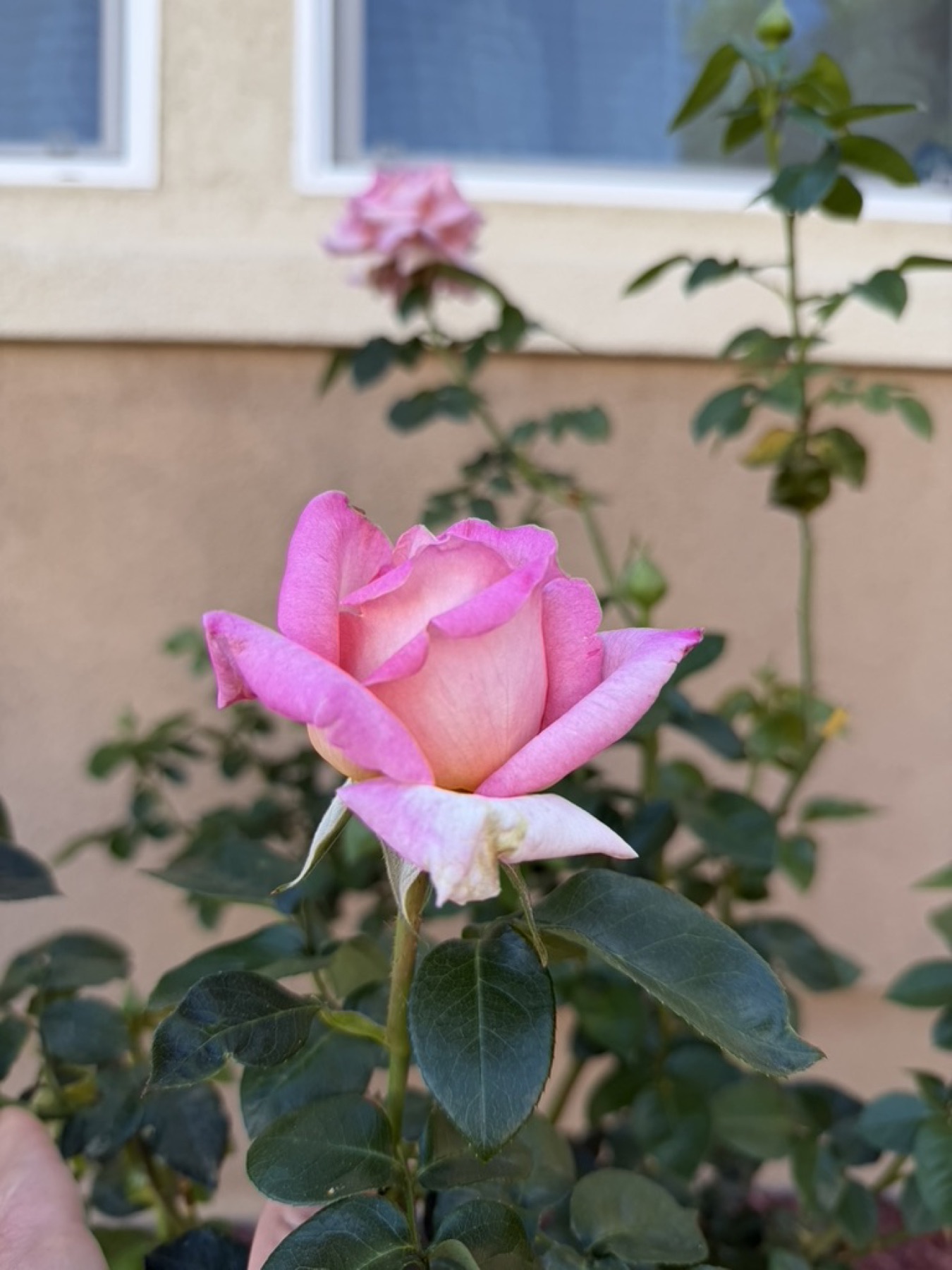
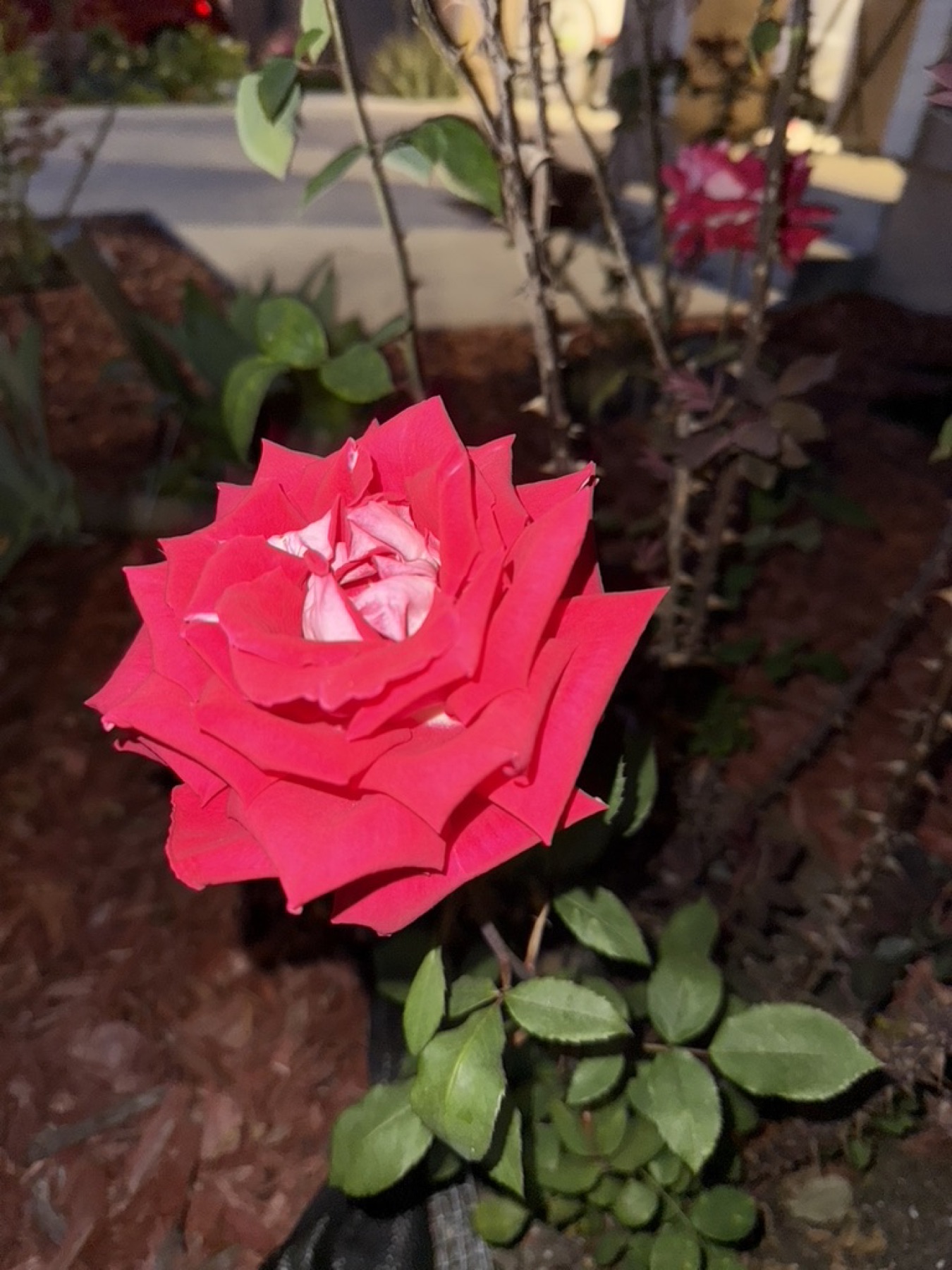
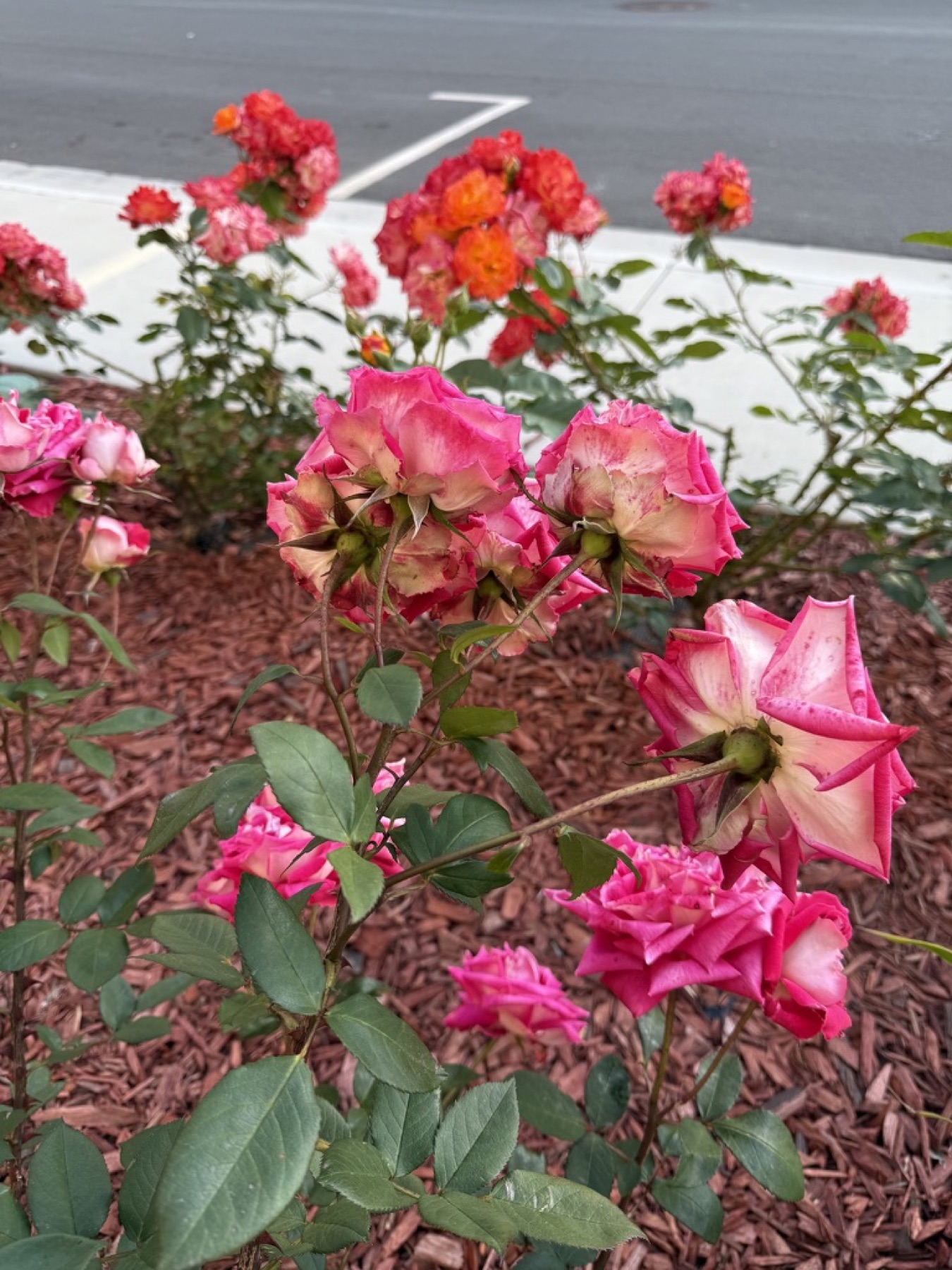
Figure 5. Other blooms in my garden, showing differences in color and flower form. From top to bottom: a yellow-and-pink bloom photographed May 29, 2026; the pink rose whose tag is missing; a red bloom photographed March 15, 2026; and an undated photograph. The second image documents the rose recorded as “cultivar unknown.” Other unconfirmed names have not been assigned from appearance alone. Photographs by the author.
4) Growing Requirements and Variety Selection
My Southern California garden has shown me that “the same yard” does not necessarily mean the same growing conditions. The front-yard roses generally receive stronger sunlight for longer periods and benefit from a more regular, calculated irrigation schedule. The three roses in the backyard receive less sun and are watered less consistently. True Gratitude receives the least sun of all and has noticeably less foliage than many of the others. Because light and watering differ together, I cannot separate their effects from these observations alone. The red rose in the backyard also has a strong fragrance that I enjoy. That is another reason I value a rose: its scent can make it worth growing even when a photograph does not capture its appeal.
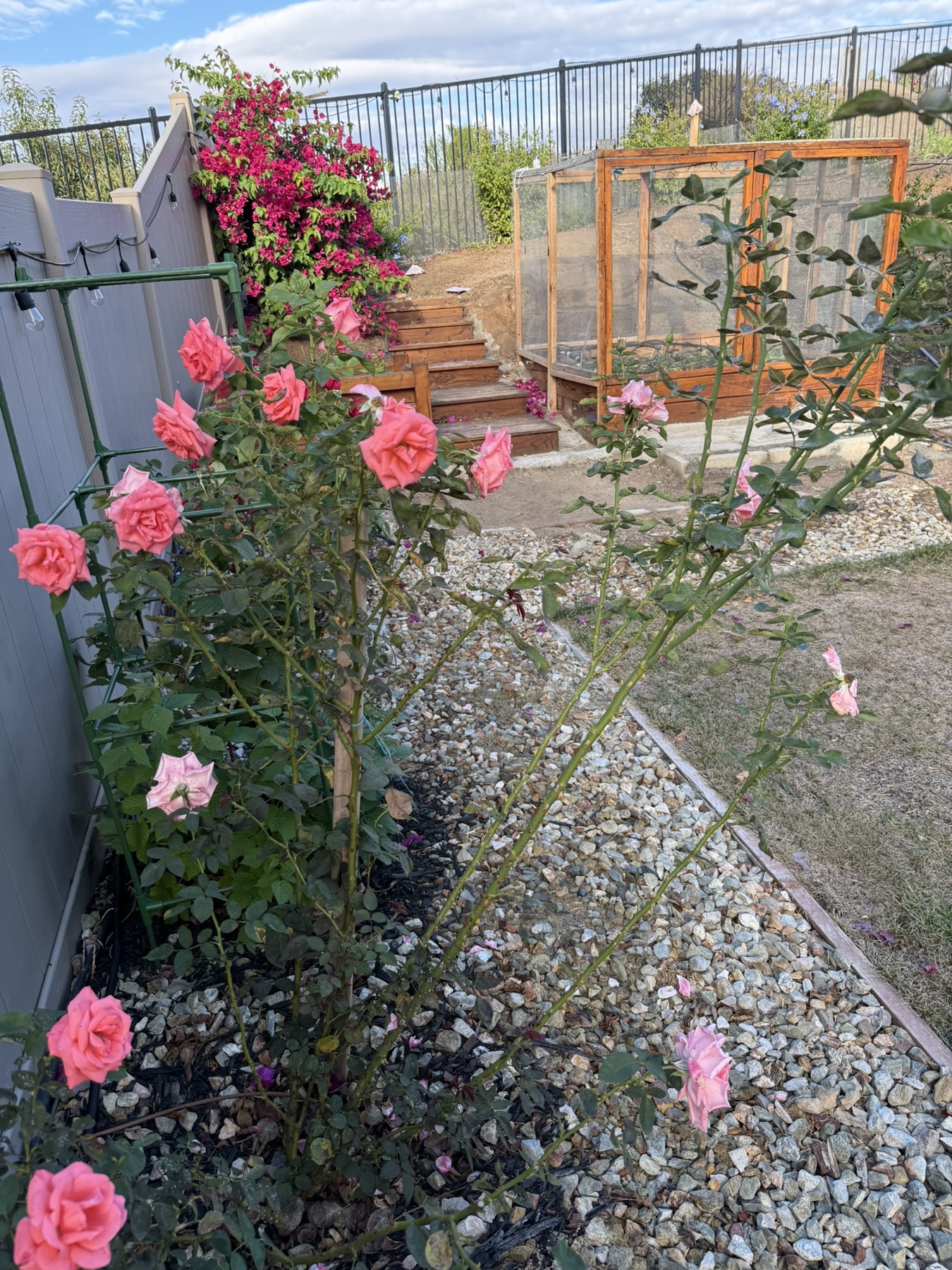
Figure 6. Backyard roses on September 18, 2025, showing flowers, foliage, and extended canes. This photograph predates the 2026 sequence and illustrates the planting setting rather than a same-season comparison. Photograph by the author.
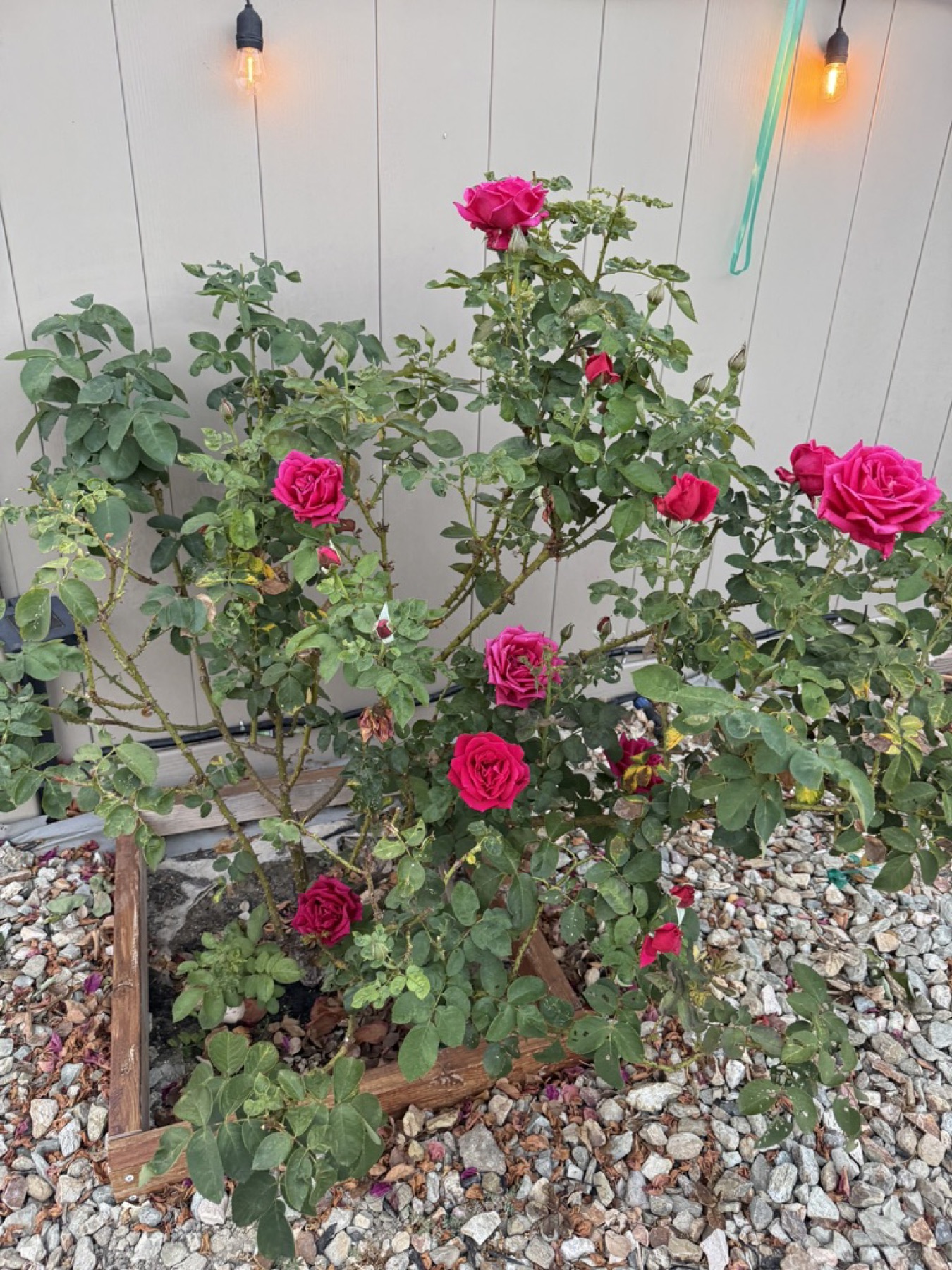
Figure 7. The fragrant red backyard rose on July 31, 2026. Its scent is an observation from my own experience; its cultivar name remains unconfirmed. Photograph by the author.
A sunny site, good drainage, and dependable moisture provide a useful starting point. UC IPM recommends six or more hours of direct sun for best performance and emphasizes adjusting irrigation to soil and weather. Both drought stress and excessive wetness can harm roses. The soil should drain freely while retaining enough water for active growth; I would use soil testing to assess fertility and pH rather than assuming that an amendment is needed. My own garden’s soil texture and pH have not yet been measured for this report (Karlik, 2019).
Temperature and seasonal development also affect the choice of rose. My photographs establish flowering by March 22, 2026, in plants installed in June 2024, about 21 months earlier. That is an observation of established plants, not the date of their first flower or a universal maturity interval. Unlike an annual vegetable, a rose may flower while it is still developing the root system and framework needed for sustained production. For a new commercial planting, I would budget an establishment season rather than promise full production immediately. Dormant-season pruning, removal of damaged wood, and space to reach the plants would be part of the site plan (Karlik, 2019).
For variety selection, I would focus on Rio Samba and Gold Medal, both of which I grow. Rio Samba earns its place because of its changing colors, clustered flowers, and personal connection to my childhood. Weeks Roses describes it as early flowering, with its best flower size and color in cool climates. Gold Medal provides a useful contrast: golden-yellow flowers, an upright habit, and substantial foliage on my front-yard plant as late as August 13. Weeks Roses classifies Rio Samba as a hybrid tea and Gold Medal as a grandiflora. Gold Medal’s observed performance makes it a useful comparison with Rio Samba, which I originally selected for its distinctive flowers. I am now planning to propagate other roses to replace Rio Sambas, making sustained plant health increasingly important in my choices. These are choices grounded in my own Southern California garden, not guarantees of performance throughout the region (Weeks Roses, n.d.-a, n.d.-b).
The most revealing comparison, however, is within Rio Samba itself. The two plants against the wall performed better overall than the two closer to the sidewalk. The wall-side plant photographed on May 3 retained substantial foliage and carried several flower clusters. This pattern makes me cautious about blaming the cultivar alone. Differences in root-zone conditions, exposure, or maintenance are possibilities to investigate, not established explanations.
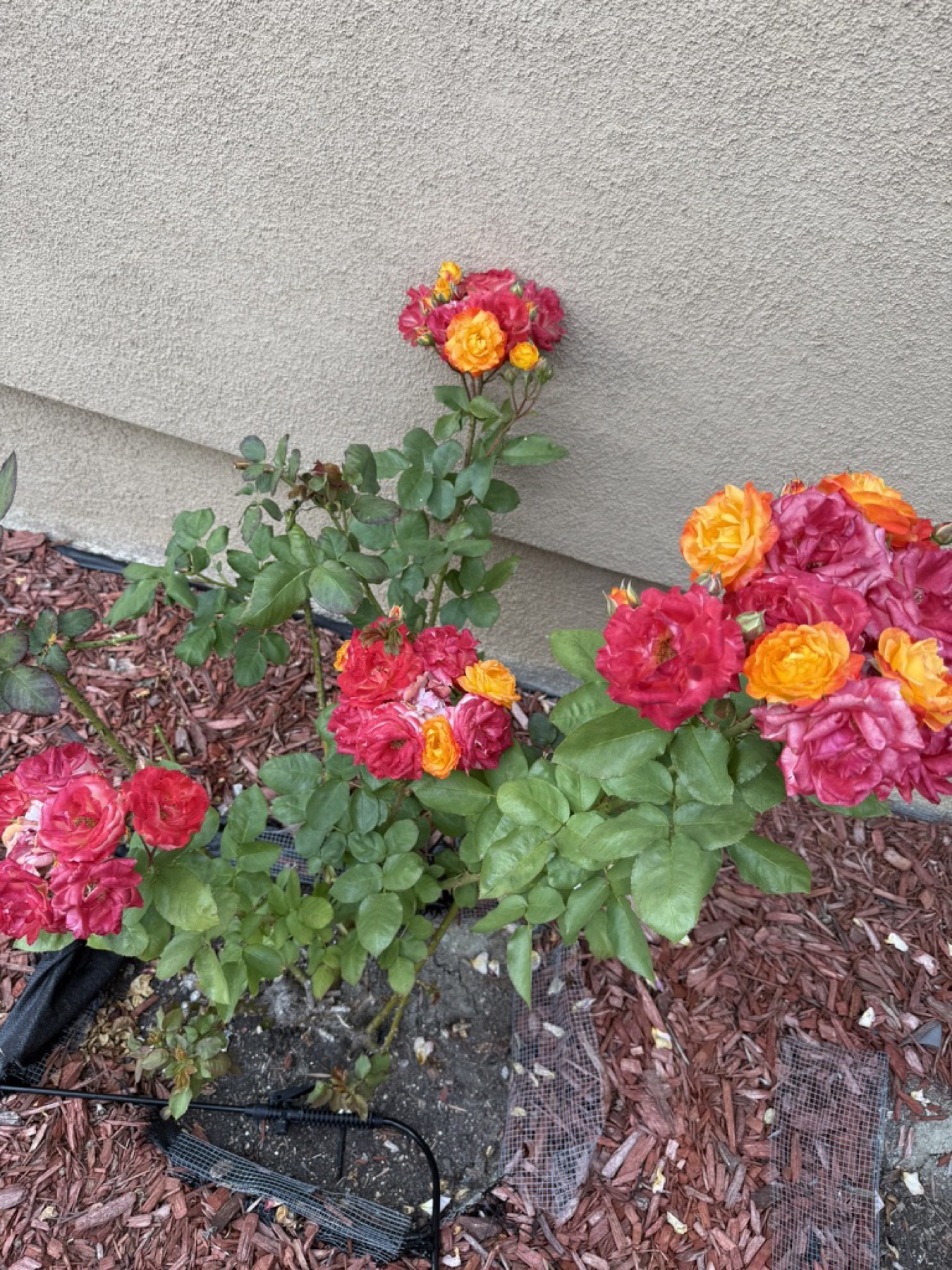
Figure 8. One of the two better-performing wall-side Rio Sambas on May 3, 2026, showing foliage and multiple flower clusters. The date comes from the image’s embedded creation metadata. Photograph by the author.
Gold Medal’s later-season foliage gives me a reason to evaluate plant health alongside flower color when choosing roses. True Gratitude provides a further contrast: its label identifies it as a climber, with a different growth habit and support requirement (Figure 1).
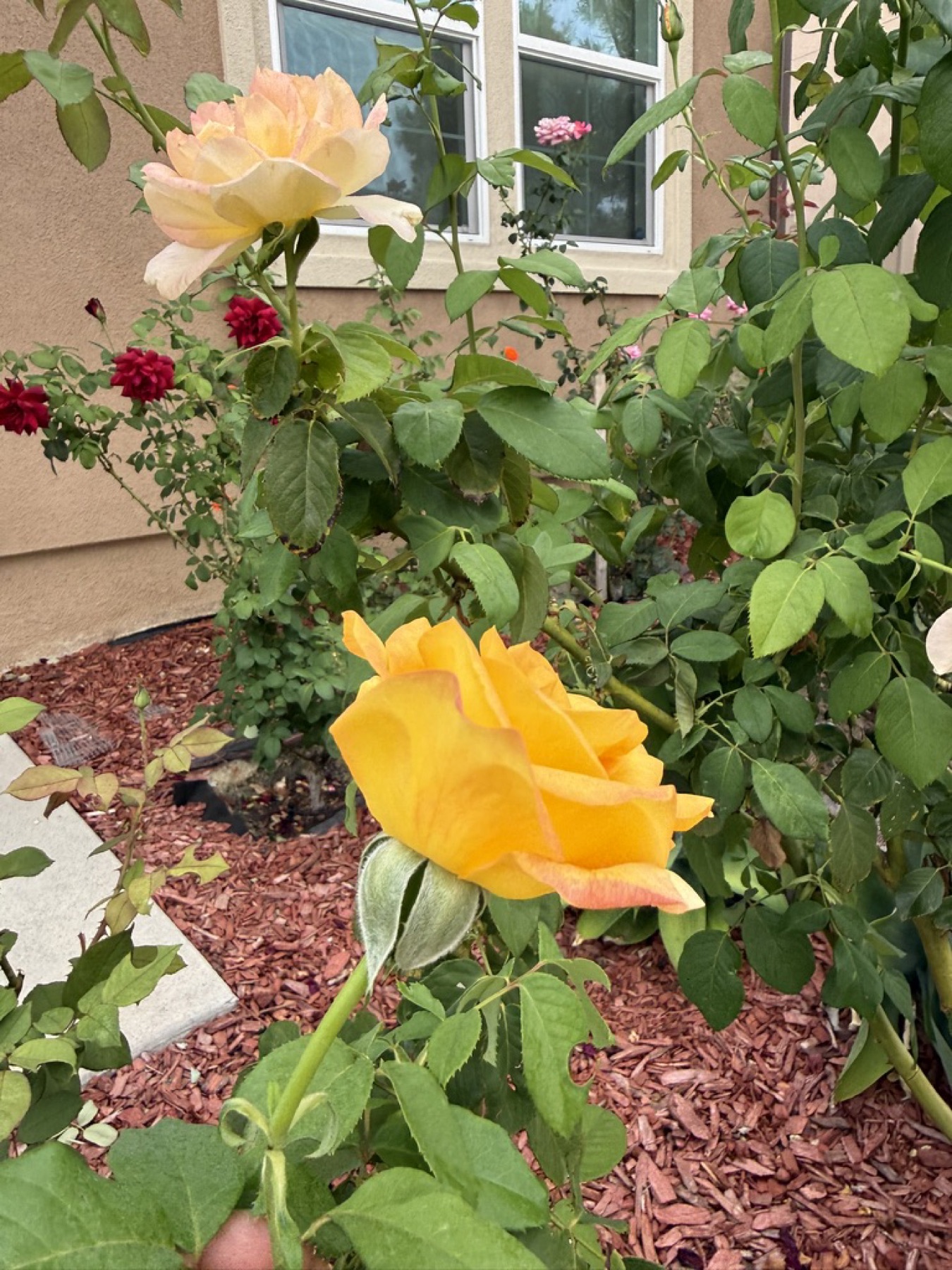
Figure 9. Front-yard Gold Medal on August 13, 2026, with open flowers and substantial foliage. This later-season observation provides a comparison with the struggling Rio Sambas, not a controlled test of cultivar resistance. Photograph by the author.
5) Propagation Methods
I have propagated roses from stem cuttings several times, working in batches. I estimate that approximately 70–80% rooted, although I did not maintain formal counts. My difficulty came later. Inconsistent watering of the pots and delays in moving the plants into larger containers contributed to losing them. The experience taught me that getting roots to form and establishing a plant that survives are separate achievements.
Roses can be propagated by seed, cuttings, layering, and, for suitable own-root plants, division. Named cultivars are reproduced vegetatively because seedlings do not reliably retain all of a parent’s characteristics. Commercial roses may also be budded or grafted onto a different rootstock. A cutting taken from the desired cultivar produces an own-root plant rather than reproducing that grafted combination (Iowa State University Extension and Outreach, 2025; North Carolina State Extension, n.d.).
For a future batch, I would use semi-hardwood stem cuttings: firm current-season growth beginning to become woody. Iowa State places this stage in mid- to late summer; in my garden, I would judge shoot maturity and avoid a period when I could not maintain moisture. Using clean tools, I would take healthy, four- to six-inch sections, remove flowers and lower leaves, and make the basal cut below a node. I would insert them about two inches into a premoistened, freely draining rooting medium such as perlite and vermiculite. A clear cover would help limit water loss, with the container kept in bright indirect light and checked daily. After a root system developed, I would gradually remove the cover and transfer the plants into individual pots, maintaining moisture through the transition (Iowa State University Extension and Outreach, 2022).
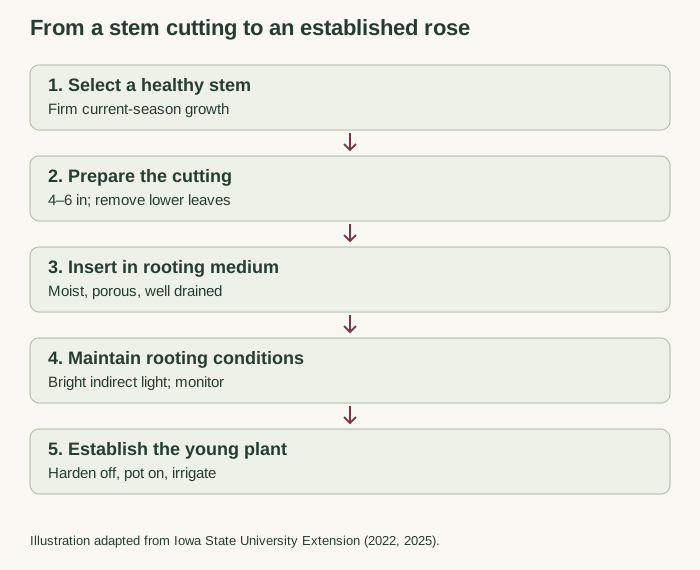
Figure 10. A proposed cutting-to-establishment workflow, adapted from Iowa State University Extension and Outreach (2022, 2025). This illustration describes the method I would follow; it does not claim that every step was used in my previous batches.
The part I would change most is aftercare. I would keep the young plants where I could inspect them daily, label each batch, and record both rooting and later survival. I would also plan for larger pots before the plants needed them. My previous results suggest that I should give that stage at least as much attention as preparing the original cuttings.
I am planning another round of stem cuttings from other roses in my garden, with the goal of raising replacement plants for Rio Sambas. I have not yet settled on the parent plants. This time, I want to carry the cuttings through rooting, potting on, and establishment before using them as replacements. My earlier rooting success gives me a starting point, but reliable watering and timely moves into larger pots will be central to whether this batch survives.
6) Nutrient Requirements
This season I began feeding my roses with Dr. Earth Total Advantage Rose & Flower Fertilizer 4-6-2. Later, I applied Alaska Morbloom 0-10-10 twice over approximately six weeks. I noticed more flowering in many roses, while Rio Samba continued to be less consistent. More recently, some plants have had less foliage. The sequence made me question whether I was paying too much attention to flowers and too little to the rest of the plant. It does not prove that a particular fertilizer caused either response.
The fertilizer numbers express nitrogen, phosphate, and potash percentages. A 0-10-10 product supplies no nitrogen, so it cannot by itself meet all nutritional needs. Nitrogen supports vegetative growth; phosphorus is involved in energy transfer and root development, while potassium supports processes including water regulation. Nitrogen deficiency can appear as poor growth and yellowing of older leaves, but excess nitrogen may favor foliage over flowers. Young leaves with yellow tissue between greener veins can indicate micronutrient problems, including iron or zinc availability. Soil pH and drainage can affect those symptoms (Karlik, 2019; Karlik et al., 2020).
For the proposed planting, I would aim for soil pH near 6.5–7.0 and use test results to guide additional nutrients. Salt accumulation and excess boron are particular concerns: boron toxicity can produce stunting, yellowing, and browning along young leaf margins. More fertilizer is therefore not an automatic answer to a plant that looks weak (Karlik et al., 2020).
For the organic fertility component, the 4-6-2 Dr. Earth product is directly relevant to my experience. Its exact trade name appears in OMRI’s published 2020 Products List as product dei-4959, and the package image I supplied carries the OMRI Listed mark. That establishes a documented listing history; a current listing still needs confirmation before this product is finalized for the proposed organic production plan (Organic Materials Review Institute, 2020). My proposed timing is an initial label-rate application as active growth begins after winter pruning, followed by a monthly assessment of growth, soil moisture, and nutrient need. Repeat application would follow the verified product label rather than an invented fixed rate or an assumption that every assessment requires feeding. The Alaska product belongs to my garden history here, not to the proposed organic input list.
My next step in understanding the thinner foliage would be to examine where leaves were lost, whether remaining leaves show a consistent symptom pattern, and whether irrigation or pest damage changed at the same time. That would give me a better basis for adjusting nutrition than the number of flowers alone.
7) Production Schedule
My photographs make the seasonal pattern tangible: Rio Samba was flowering in March and April, a wall-side plant was still carrying foliage and flowers in early May, and the June 20 photographs document the first decline I noticed. Gold Medal remained leafy in August. These observations help me think about timing, but they do not measure how many marketable stems my garden could supply on a particular day.
For the class production scenario, I would plan a new planting for a 100-member CSA, with a target distribution of June 1, 2028. I would plant nursery-grown dormant stock in January–February 2027 and allow the first season for establishment. The planning interval is therefore roughly 16–17 months from planting to the distribution date, rather than a biological days-to-maturity claim. The assumed order is five stems per member, or 500 stems. It is a production target to test against actual records, not a guaranteed yield.
| Production step | Proposed date or timeframe |
|---|---|
| Test soil, design irrigation, and order healthy nursery plants | November–December 2026 |
| Plant dormant nursery stock | January–February 2027 |
| Establish roots and monitor irrigation, weeds, and pests | Spring 2027 |
| Record growth, flowering dates, and usable stem quality | Spring–fall 2027 |
| Prune and remove damaged wood and diseased debris | January–February 2028 |
| Monitor new growth and maintain irrigation and nutrition | March–May 2028 |
| Use observed bud development to assess the likely harvest window | May 2028 |
| Harvest suitable stems close to distribution, allowing appropriate handling | Late May–June 1, 2028 |
| Distribute the planned CSA allocation | June 1, 2028 |
The schedule assumes established nursery stock, a sunny site, functioning irrigation, and adequate pest management. It does not assume that I can force all cultivars to flower together. UC’s California guidance supports winter pruning before bud swell in most locations; records from the first production season would help refine later timing (Karlik, 2019). Starting from my own cuttings would introduce another establishment stage, especially given my previous losses, so I would not treat rooted cuttings as equivalent to ready-to-plant nursery stock.
For the 264-plant layout in section 8, a 500-stem allocation would require an average of about 1.9 marketable stems per planted rose within the harvest window. That arithmetic does not establish that the yield is attainable. Plant survival, stem quality, cultivar timing, and reserve capacity would all affect whether the order could be filled.
8) Spacing and Planting Layout
I considered spacing when I planted my roses in June 2024. Their later performance has also made me pay attention to location within the garden: two Rio Sambas near the wall performed better overall than the two nearer the sidewalk, while front- and backyard conditions differed in sunlight and irrigation. My hand sketch, based on approximate iPhone measurements, records ten front-garden roses: four Rio Sambas, Meredith, Peace, Gold Medal, Peak Performance, Chrysler Imperial, and one pink rose whose tag is missing. Several neighboring plants are marked approximately 36 inches apart, with two shorter distances marked approximately 24 inches. These measurements document that spacing was part of my planting decisions; they do not establish spacing as the cause of the plants’ different performance.
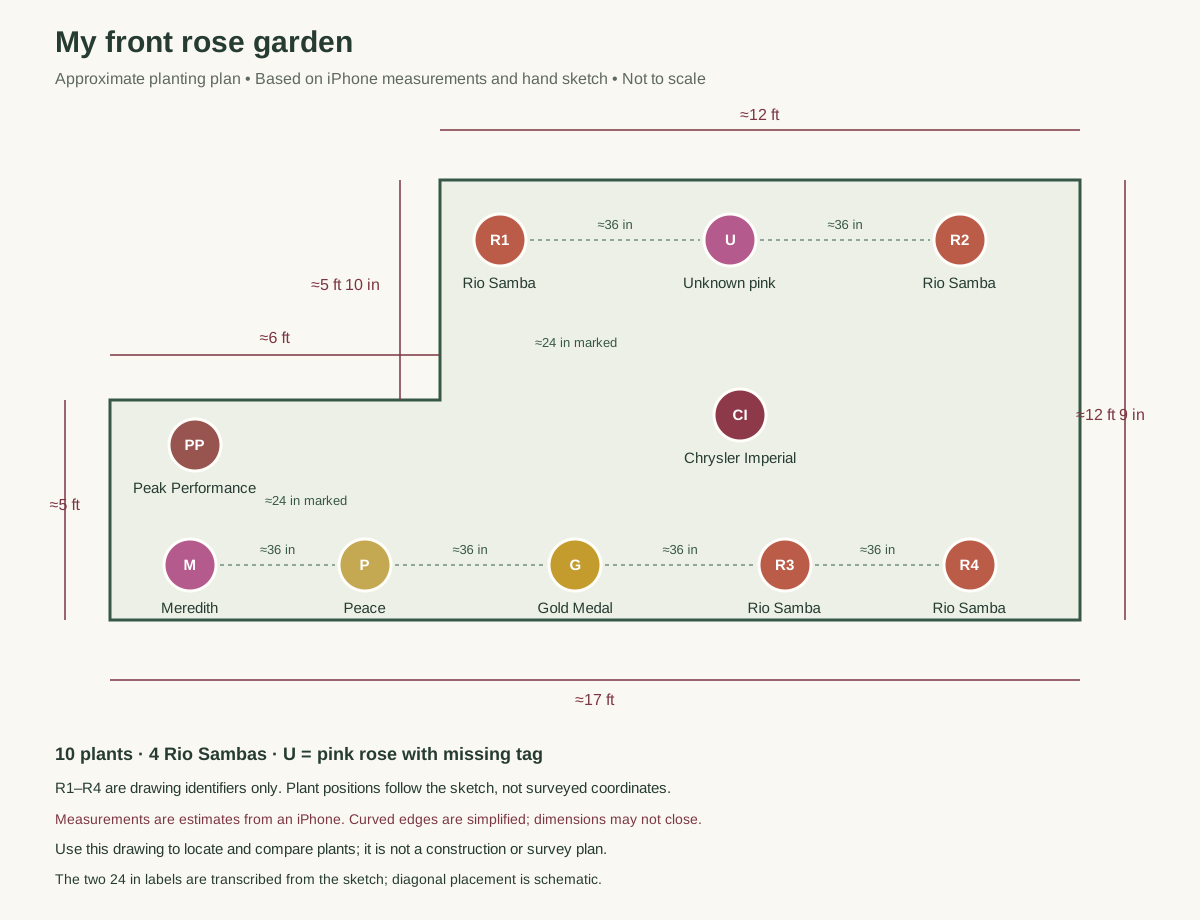
Figure 11. My front-garden planting arrangement, redrawn from my hand sketch and approximate iPhone measurements. Curved boundaries are simplified, and the dimensions are estimates rather than a geometrically closed survey. The drawing is not to scale. The unknown pink rose is labeled U; R1–R4 identify the four Rio Sambas. Positions show the arrangement rather than exact plant coordinates.
The home-garden drawing records the existing planting. The larger layout below is the separate hypothetical production area required by the class assignment.
For the assignment’s 50-by-100-foot planting area, I would use three feet between plants within rows and six feet between row centers. These are proposed design choices for upright hybrid teas, with wider row spacing intended to provide access for pruning, monitoring, irrigation maintenance, and harvest. Actual cultivar width would need to be checked before installation, and a spreading cultivar could require more room. Air circulation and access are relevant to plant health as well as convenience (Karlik, 2019).
Across the 50-foot width, eight row centers at six-foot intervals occupy 42 feet, leaving four feet from each outside row center to the plot edge. Along each 100-foot row, 33 plants at three-foot intervals occupy 96 feet between the first and last plant centers, leaving two feet at each end. The proposed total is therefore eight rows multiplied by 33 plants, or 264 roses. Extra turning space or wider perimeter access would reduce the count.
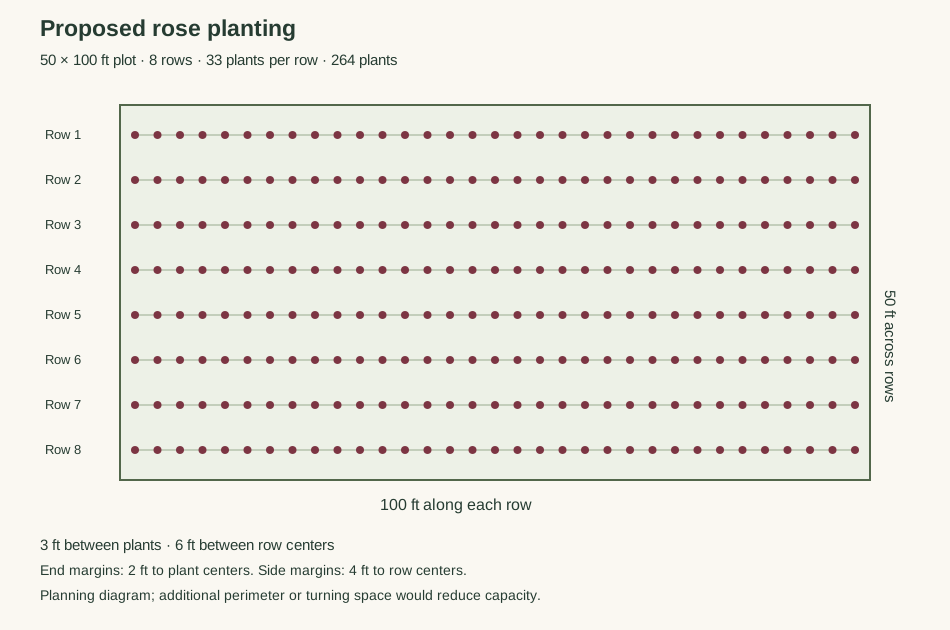
Figure 12. Proposed planting layout for the class scenario. Each dot represents one rose. Dimensions describe distances between plant or row centers, not the clear passage remaining after mature plants fill out.
The layout would need an irrigation design that serves every row consistently. My front-yard experience makes that a priority: regular watering is easier to maintain when it is built into the system. A production plot should also make routine inspection and deadheading easy enough to continue after the excitement of the first bloom has passed.
9) Integrated Pest Management
The June 20 photographs mark the beginning of the decline I noticed in Rio Samba during 2026. They show numerous holes and missing areas in the leaves, together with faded and browning flowers. Some plants had earlier produced long, thick canes; later I noticed spotting, a woodier appearance, and shorter growth, and I cut the struggling plants back heavily. Those observations describe what happened, but they do not identify a single pest or disease responsible for the entire decline.
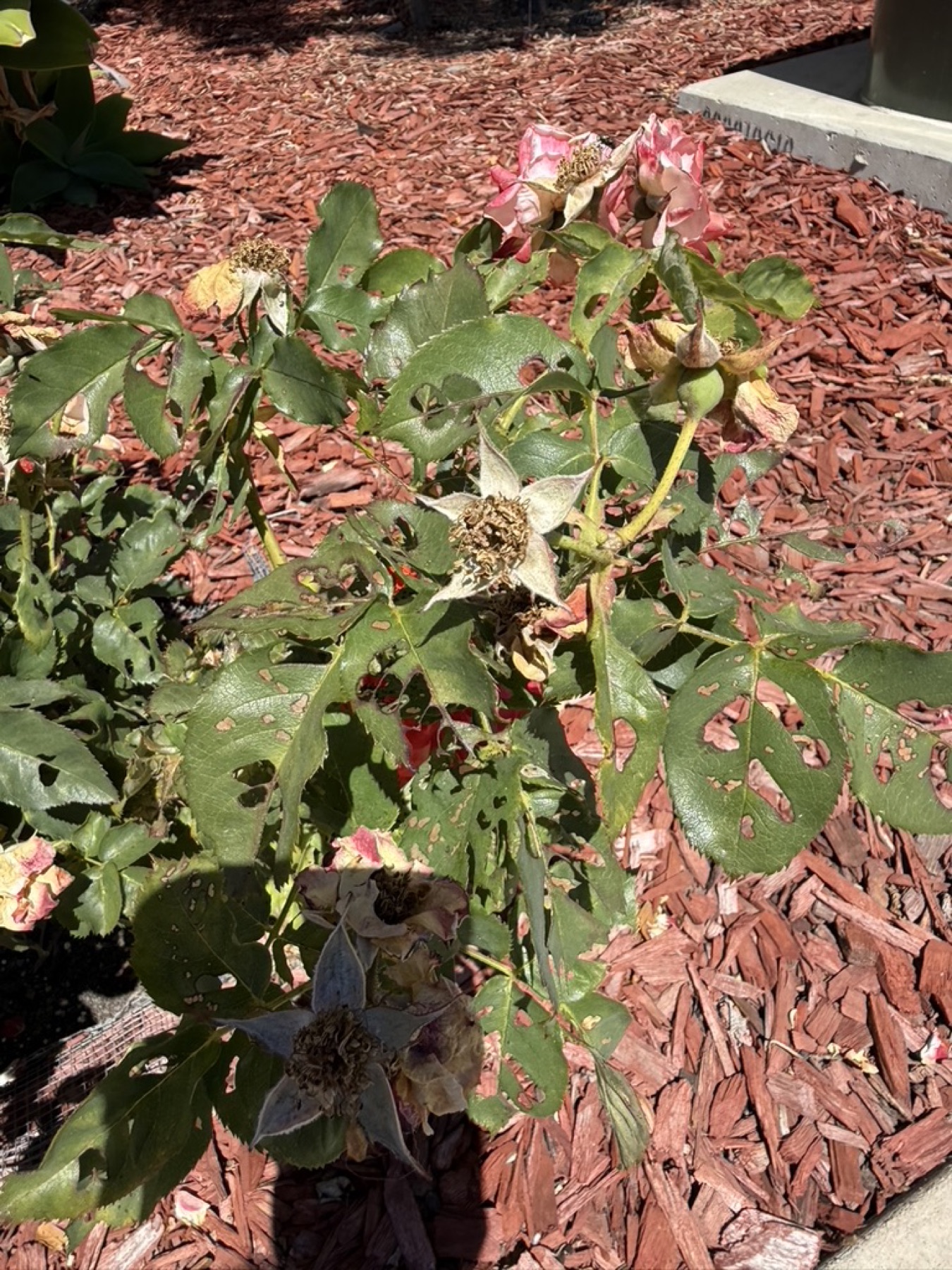
Figure 13. Rio Samba foliage on June 20, 2026, showing irregular holes and missing leaf tissue. This photograph documents damage without confirming the organism responsible. Photograph by the author.
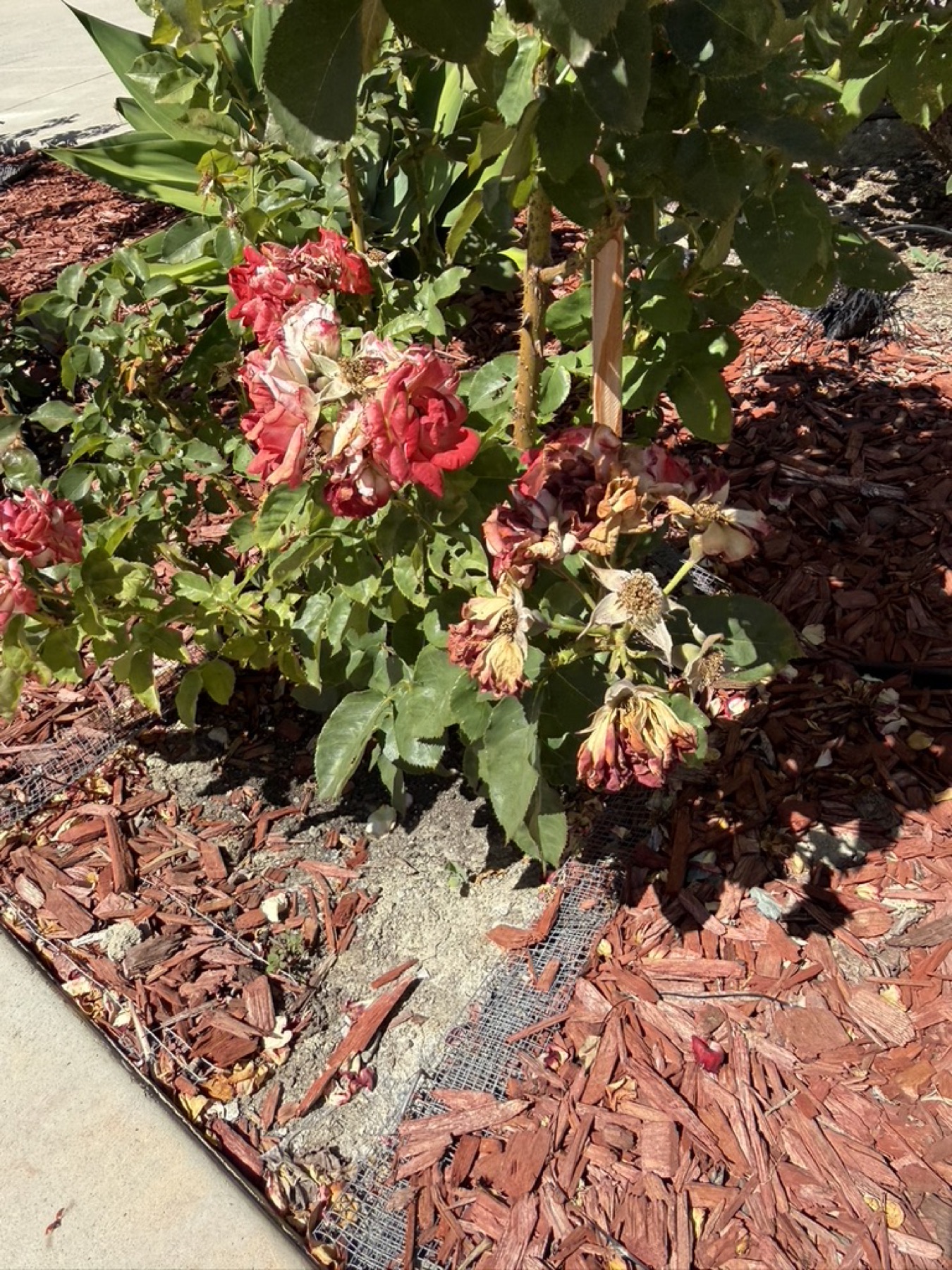
Figure 14. A wider view on June 20, 2026, showing damaged foliage and retained faded flowers. Bloom age and maintenance need to be considered separately from the cause of leaf damage. Photograph by the author.
Five problems I would monitor are rose sawflies, aphids, spider mites, powdery mildew, and black spot. Sawfly larvae, often called roseslugs, can scrape leaf surfaces and, depending on species and age, chew holes. Their damage makes them a possibility to investigate in relation to my photographs; finding larvae on affected leaves would provide stronger evidence. Aphids gather on tender shoots and buds, sometimes distorting growth and leaving honeydew. Spider mites can produce fine stippling and leaf loss and are associated with hot, dry, dusty conditions (UC IPM, n.d.; Flint & Karlik, 2019).
Powdery mildew produces pale powdery growth on leaves and shoots. Black spot produces dark lesions with feathery margins and is favored by extended leaf wetness. Neither disease should be diagnosed simply because a plant has damaged leaves or old flowers. The June photographs are particularly useful for documenting missing tissue, while closer inspection would be needed to distinguish feeding injury from other causes and to evaluate any separate disease symptoms (Karlik et al., 2020).
My actual treatment history includes two early-season applications of BioAdvanced Disease Control and later use of BioAdvanced Rose & Flower Spray, with uneven follow-through as the season progressed. In late September or early October, I recall making two spray applications roughly two weeks apart, although I did not keep exact dates. Registered concentrate labels identify Disease Control as tebuconazole 2.9% and the All-in-One Rose & Flower Spray formulation as tau-fluvalinate 0.61% plus tebuconazole 0.65%. Those percentages describe the packaged concentrates, and the matching bottle registration determines the applicable label (U.S. Environmental Protection Agency, 2017, 2022). This history should not be mistaken for a tested explanation of why one plant recovered or another declined.
My maintenance changes through the season as well. Early on, I am good about deadheading and removing damaged leaves. Later, I sometimes leave spent flowers for two or three weeks. One practice I have maintained consistently is using clean tools and sanitizing them between plants, even when I fall behind on other maintenance. That helps explain why faded blooms remain in photographs, but it does not establish the cause of the holes in the leaves. It also means that a useful pest-management plan has to be one I can maintain after the early-season enthusiasm fades.
For the proposed organic planting, I would use regular inspection, direct removal of visible pests where practical, conservation of natural enemies, and sanitation as the core strategies. A weekly inspection would include buds, new shoots, and leaf undersides, with notes and photographs tied to individual plants. I would inspect damaged leaves for roseslugs rather than choose a treatment from holes alone. Consistent irrigation, suitable spacing, and removal of diseased debris would support prevention. Where water is used to dislodge pests, morning washing would allow foliage to dry. These approaches are supported by UC’s rose pest guidance (Flint & Karlik, 2019; Karlik et al., 2020).
The BioAdvanced products are recorded here as part of my garden history, not included as inputs in the proposed organic plan. That plan recommends no pesticide product; any future addition would require verification of the exact product’s OMRI listing. The most useful improvement I can make now is consistent observation. Comparing the two wall-side Rio Sambas with the two sidewalk-side plants, while recording irrigation, maintenance, and visible symptoms, would help me ask better questions about their performance.
References
Barrett, J. (2013). Yes, you can grow roses. Texas A&M University Press.
Boskabady, M. H., Shafei, M. N., Saberi, Z., & Amini, S. (2011). Pharmacological effects of Rosa damascena. Iranian Journal of Basic Medical Sciences, 14(4), 295–307. Full text.
Flint, M. L., & Karlik, J. F. (2019). Roses: Insects and mites (UC ANR Publication 7466). University of California Statewide Integrated Pest Management Program. Pest Notes.
Iowa State University Extension and Outreach. (2022). Propagation of deciduous trees and shrubs from semi-hardwood cuttings. Reviewed October 2022. Propagation guide.
Iowa State University Extension and Outreach. (2025). How to propagate roses. Reviewed February 2025. Rose propagation.
Karlik, J. F. (2019). Roses: Cultural practices and weed control (UC ANR Publication 7465). University of California Statewide Integrated Pest Management Program. Pest Notes.
Karlik, J. F., Al Rwahnih, M., & Golino, D. A. (2020). Roses: Diseases and abiotic disorders (UC ANR Publication 7463). University of California Statewide Integrated Pest Management Program. Pest Notes.
Kılıç, T. (2023). Identifying successful combinations by fertility index in old garden roses and hybrid tea roses crosses. PeerJ, 11, e15526. Article.
North Carolina State Extension. (n.d.). Rosa. North Carolina Extension Gardener Plant Toolbox. Plant profile.
Organic Materials Review Institute. (2020). OMRI Products List 2020. Entry for Dr. Earth Total Advantage Rose & Flower Fertilizer 4-6-2, product dei-4959. Published list.
Scott, S. (2023, May 9). U.S. imports of cut flowers and nursery products grew to $3.3 billion in 2022. USDA Economic Research Service. Trade snapshot.
UC IPM. (n.d.). Rose sawflies (roseslugs). University of California Statewide Integrated Pest Management Program. Pest profile.
U.S. Environmental Protection Agency. (2017, May 5). Tebuconazole 2.9% SE concentrate systemic fungicide [Registered label, EPA registration 92564-5]. Label.
U.S. Environmental Protection Agency. (2022, January 6). Tau-fluvalinate + tebuconazole concentrate insecticide, miticide, and fungicide [Registered label, EPA registration 92564-63]. Label.
Weeks Roses. (n.d.-a). Gold Medal. Cultivar profile.
Weeks Roses. (n.d.-b). Rio Samba. Cultivar profile.
Editorial notes for the next revision
These notes are outside the report text and should be removed before submission.
The current OMRI listing and full application directions for the exact Dr. Earth 4-6-2 formulation still need confirmation. The package image and the historical OMRI list are supporting evidence, but neither establishes current listing status. Section 6 therefore remains conditional rather than claiming that current certification has been verified.
Section 2 now includes a dated trade-value figure, but it still needs current rose-specific production locations and quantities to fully address that part of the prompt. Import value should not be presented as worldwide production volume. Section 3 also needs a rose-hip photograph to meet the request for plant, flower, and fruit images. No supplied image has been labeled as a hip photograph.
The front-garden drawing in section 8 uses approximate iPhone measurements. The gardener notes that curved edges and measurement uncertainty may explain the differences between boundary totals. Keep it labeled as an approximate plan, not to scale; a scaled survey is not required for illustrating the existing arrangement. Additional site measurements would strengthen section 4: approximate mature plant widths, direct-sun hours, irrigation amounts, and soil texture or test results. A precise climate-zone number or temperature limit has not been inferred from the coordinates. The variety comparison intentionally pairs hybrid tea Rio Samba with grandiflora Gold Medal; Gold Medal is not classified as a hybrid tea.
The image metadata dates the wall-side photograph to May 3, 2026, rather than the initially recalled May 13. The newly supplied backyard overview is dated September 18, 2025; the fragrant red backyard rose is dated July 31, 2026. The final gallery photograph has no readable creation date. Names for the newly supplied blooms remain to be confirmed. Treatment dates and the 70–80% rooting estimate remain recollections, not formal records. Sections 10–12 have not been drafted in this revision.